Generative Video Enters Hotel Marketing: How Can Gemini Omni 1.1 Flash Be Used for Short-Form Hospitality Videos?
Generative video is moving from simply 'making a visually appealing clip' into a controllable content production workflow. Google DeepMind announced Gemini Omni 1.1 Flash on August 27, 2026, adding scene extension, first-and-last-frame interpolation, fast 360p drafts, 1080p/4K output, and video reference capabilities. For hotels, these tools can support room-type introductions, food and beverage promotions, events, and social short-form videos. The key, however, is not to make nonexistent facilities look more attractive, but to use AI to reduce editing and version-production costs while keeping information truthful.
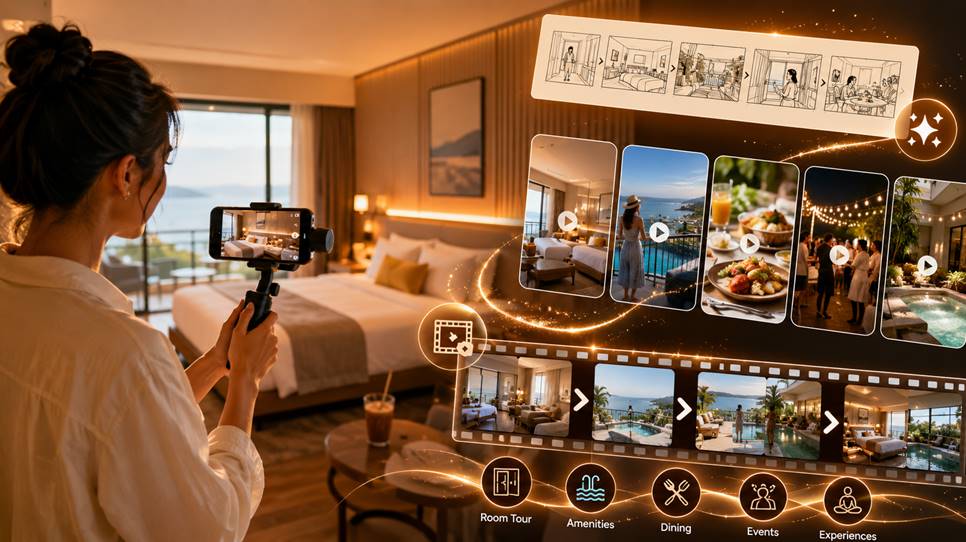
Figure 1 | Generative video can help hotels turn existing photos and short clips into more social media assets, but the visuals must still be checked against the actual property environment.
1. What AI Technology Are We Introducing Today?
The technology introduced here is controllable generative video. A common problem with traditional text-to-video generation is that individual shots are not continuous, and people or spaces can easily change from one clip to the next, making the results difficult to use directly in branded content. The recent Gemini Omni 1.1 Flash update focuses on 'continuing existing scenes' and 'controlling the starting and ending frames,' giving users more directional control when creating continuous shots.
Google stated on August 27, 2026, that Omni 1.1 Flash can analyze up to 10 seconds of preceding video context and extend a video in 10-second increments, up to a cumulative maximum of 40 seconds. It also provides 360p draft previews, 1080p or 4K output, and up to 3 seconds of video reference. For hospitality content, the value of these capabilities is that they make it easier to extend short source material into a complete narrative rather than relying on a single generation attempt and hoping for the right result.
2. What Can This Technology Do?
First, it can extend existing scenes. For example, you can shoot a 6-second smartphone clip of entering a guest room, then generate a natural continuation moving toward the window or bathroom. Second, you can specify the first and last frames so that a shot transitions smoothly from the hotel exterior to the lobby or guest room, lowering the production barrier for transitions. Third, you can create multiple low-resolution drafts first, confirm the composition and motion, and only then output a high-resolution version, avoiding the highest-cost setting for every test. Fourth, a short video can be used as a reference to maintain character or motion continuity.
Confirmed technical capabilities do not mean that every hotel can use generated results directly as advertising. The model may still alter furniture, spatial proportions, views outside the window, or details of dishes. Hotels therefore need to make 'whether the visuals match the actual property' a formal review item.
3. How Can the Hospitality Industry Use It?
Application Scenario 1 | Room-Type Introductions. Producing a complete room tour traditionally requires filming, a stabilizer, editing, and multiple reshoots. AI can use real room photos or short clips to help create transitions, extended shots, and versions of different lengths. Staff still need to verify the bed type, perceived room size, amenities, views, and circulation flow, and must not allow AI to invent a bathtub or ocean view that does not exist.
Application Scenario 2 | Social Short-Form Video. Marketers can extend the same set of hotel assets into 15-second, 30-second, or differently paced Reels/Shorts. AI can help fill in shots and create variants, while staff remain responsible for scripts, brand voice, subtitles, music licensing, and publishing. This can reduce the repetitive work of 'recutting a new version for every platform.'
Application Scenario 3 | Food and Beverage and Event Promotion. Hotels can use actual dishes, banquet halls, or seasonal decorations as references to generate scene transitions or atmospheric shots. Staff must ensure that dishes, prices, event dates, and spatial layouts continue to reflect actual information. AI is well suited to strengthening the narrative, but not to replacing product facts.
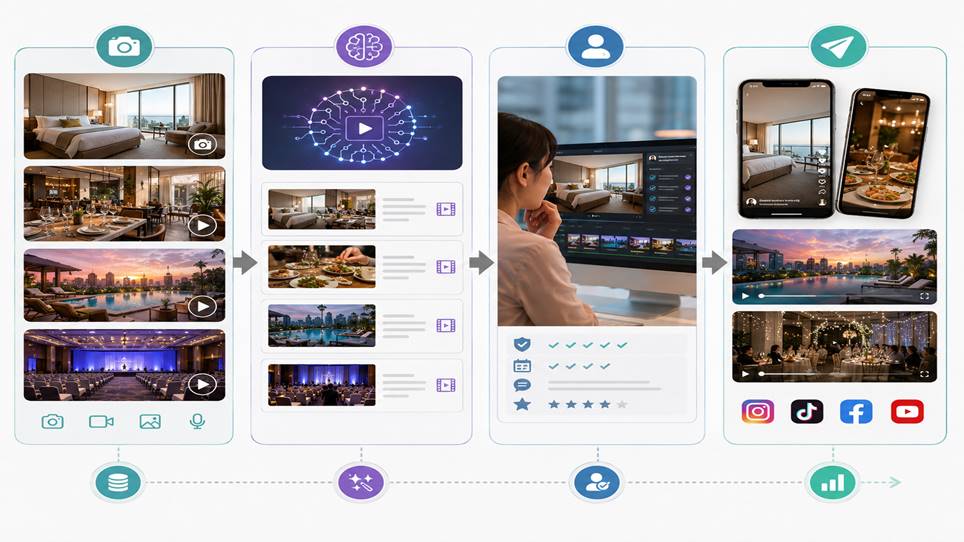
Figure 2 | When hotels use AI video, real source material and human review should remain at the core of the workflow.
4. How Can the Hospitality Industry Implement It?
The first step is to create 'may generate' and 'must not generate' lists. Content that may be generated usually includes camera movement, transitions, and atmospheric extensions. Content that must not be generated includes facilities, room types, window views, food portion sizes, and service promises that could mislead consumers. The second step is to organize owned materials for which the hotel holds the necessary rights and usage consent, and build a unified reference library for room types and public spaces.
The third step is to generate multiple low-resolution drafts, changing only one variable at a time, such as camera movement or lighting, and then have marketing and operations review them together. The fourth step is to output a high-resolution version only after everything has been confirmed. Finally, retain the prompts, original source materials, and approved versions so they can be traced in the future.
5. What Results Can It Achieve?
Trackable metrics include the average production time per video, the number of usable videos produced each month, the percentage of drafts that are formally adopted, asset reuse rate, hours of manual editing, video completion rate, social engagement rate, and clicks to the official website. These metrics can measure workflow efficiency, but growth in views cannot be attributed entirely to AI.
For hotels with multiple properties, multiple room types, or seasonal campaigns, the greatest value of generative video is usually 'turning the same set of real source materials into different versions more quickly,' rather than eliminating filming altogether. Hotels with strict brand-consistency requirements have an even greater need to retain live-action footage as their core source material.
6. Risks and Considerations
The greatest risks are visual inaccuracies and misleading advertising. If AI adds furniture, views, or spatial dimensions that do not exist, it may create a gap between guest expectations and reality. Another issue is portrait rights and copyright: usage rights should be confirmed for guests, employees, photographic works, music, and brand assets.
Hotels also need to consider vendor costs, generation speed, data-use terms after materials are uploaded, and the staff resources required for content review. For emergency escape routes, accessibility facilities, room layouts, food portion sizes, and any information that carries legal or consumer-dispute risk, AI visuals alone are not appropriate. Actual photos and written descriptions should be the primary sources of information.
7. Conclusion
Generative video is best introduced first in hotel marketing tasks where 'real source materials already exist, but many edited versions are needed.' Treating AI as an assistant for post-production and creative extension, rather than as a tool for fabricating the hotel environment, is the way to balance efficiency and trust. At the initial stage of implementation, it is advisable to start with one room type or one campaign, establish a record of drafts, human verification, and publishing, and then expand gradually.
8. Sources
• Original article or document title: Gemini Omni 1.1 Flash lets you build with more control
Publisher: Google / Google DeepMind
Authors: Anish Nangia, Alisa Fortin
Publication date: 2026-08-27
Original URL: https://blog.google/innovation-and-ai/technology/developers-tools/build-with-gemini-omni-1-1-flash/
Information referenced in this article: technical information on scene extension, first- and last-frame control, 360p drafts, 1080p/4K output, video references, and the length of extension context.
9. FAQ
Are Small B&Bs and Guesthouses Also Suitable for Generative Video?
Yes. They can start with a small amount of social media content, but it should still be based on real room and property materials, avoiding the generation of facilities that do not exist.
Does Implementation Require a Professional Video Editor?
Not necessarily. AI can lower some technical barriers, but people are still needed to handle scripts, brand judgment, material licensing, and final review.
Can AI Video Completely Replace Live-Action Filming?
It is not recommended. Hospitality sales depend heavily on accurate information about physical spaces, so live-action footage should remain the core material, while AI is better suited to extensions and versioning.
How Can Hotels Prevent AI Visuals from Misleading Guests?
Create a 'must not generate' list, and have staff who are familiar with the actual property verify every image of room types, facilities, views, and food before publication.
How Can Hotels Determine Whether the Implementation Is Effective?
Compare video production time, manual editing hours, asset utilization rate, adoption rate, and post-publication metrics such as completion rate, engagement rate, and clicks to the official website.
- Drowning in Email, Meetings, and CRM Every Day: Can an AI Assistant Really Help? The New Management Workflow Enabled by Amazon Quick Desktop
- Setup Guide for Domestic Travel Subsidy Package (Collection on Behalf)
- Generative Video Enters Hotel Marketing: How Can Gemini Omni 1.1 Flash Be Used for Short-Form Hospitality Videos?
- Tutorial on Setting Up Domestic Travel Subsidy Special Offer for Hotel Operators
- 2026 Domestic Travel Subsidy Deals (Traveler Edition)